Home Blog Page 285

County reports first COVID-19 death

 Health Department reports highest one day jump on Sunday

By Jeremy D. Wells
Carter County Times

 The Carter County Health Department reported on Monday that the county has experienced their first COVID-19 related death. 

“It comes with great sadness that I have to report our first COVID death in our county,” Carter County Health Department director Jeff Barker wrote on his Facebook page. “I want to extend our condolences to the family from all of us here at the Health Department.”

Barker also took the opportunity to update the county on the total number of cases and to ask Carter County residents to, “please… wear your mask(s).” 

Barker reported three new cases on Monday. That was in addition to eight new cases reported on Sunday, the highest single day jump since last Sunday when seven new cases in the Carter County Jail brought the total number of cases in the county to 40 at that time. Another case added last Monday raised that number to 41. 

With four cases added last Wednesday, July 8, single cases reported on Thursday, July 9 and Saturday, July 11, the eight new cases added to the count this past Sunday, and three new cases on Monday, the total number of positive cases for the county has reached 58. Of those, the health department reported, 24 have recovered, 30 are isolating at their residence, three are hospitalized – however one of those hospitalized was due to non-COVID related issues – and one, as noted, has passed away. 

“This should be a reminder to all of our residents that this virus is real,” Barker wrote. “We need to be doing all we can as individuals and as a community to protect each other. Please guys, wear your mask(s). Let’s see what happens over the next 30 days.” 

Contact the writer at editor@cartercountytimes.com. 

Pond turnover could be why the fish in your pond are dying

By: Rebecca Konopka
Carter County Extension Agent

Each summer through the early fall, we get questions from landowners searching for reasons why fish are dying in their ponds. Pond turnover is often the answer. 

During the summer months, water can become stagnant and stratify, which means it separates into distinct layers of cool and warm water. This occurs because the sun only penetrates the water closest to the surface. Since the sun is unable to penetrate to the water at deeper depths, that water stays cooler. These waters will start to mix when cooler air temperatures begin to arrive and cool the surface water. Heavy rains or strong winds can mix pond water too. This mixing process is called pond turnover. 

When the water from the lower depths of the pond reaches the surface, it may not be as oxygenated as the previous surface water. This is because water in the bottom of the pond may have a higher organic matter content and fewer oxygen producing plants. Fish need dissolved oxygen to live. This water may also contain gases, such as hydrogen sulfide, which are toxic to fish. When turnover occurs, it can cause an algal bloom die-off, a fish kill due to low dissolved oxygen, or both. 

Turnover usually only occurs during the warmer months of the year. Late fall, winter and early spring typically have lower surface water temperatures, and wind and rain help pond waters stay well mixed and maintain a more uniform temperature. 

People will build commercial fish production ponds at shallower depths to prevent pond turnover. For existing ponds, the only way to prevent turnover is to install a system that mechanically aerates or mixes the pond and circulates the water from spring through fall. However, these systems are often expensive. 

If you have dead fish in your pond, you can allow the fish to decompose in the water. You can also remove and discard the fish, but they may smell far more pungent on land than in the water. 

More information on pond management is available at the Carter County office of the University of Kentucky Cooperative Extension Service, or by contacting the Division of Aquaculture at Kentucky State University. 

Educational programs of the Cooperative Extension Service serve all people regardless of economic or social status and will not discriminate on the basis of race, color, ethnic origin, national origin, creed, religion, political belief, sex, sexual orientation, gender identity, gender expressions, pregnancy, marital status, genetic information, age, veteran status, or physical or mental disability. 

As we see it: Support your community, shop local

Back to school season will soon be upon us. That means school shopping and back to school sales. Whether you choose to send your kids back to school in a traditional classroom setting, or keep them home and choose non-traditional instruction until the COVID-19 crisis improves, you are going to have to buy certain school supplies. With the way kids grow and (if they’re like ours) how rough they are on clothing, you’re likely going to need to buy them new shoes and clothes whether you send them back for traditional instruction or keep them at home. 

When you do go to buy those school supplies and new clothes, we highly recommend that you choose to buy them, as much as possible, from locally owned and operated shops and businesses. Sure, you might be able to find something at a big box store for a couple of dollars cheaper sometimes. But by the time you add in the extra gas and the extra time to run to a big box store in a neighboring city, or to the mall in a neighboring state, how much money are you really saving? 

Even if, after accounting for the gas, the time, and the hassle of fighting the crowds, you do still end up saving a couple of dollars by making those trips, you have to ask yourself, “where does that money go?” In most cases the majority of it goes to big corporations that aren’t located anywhere near us. Some of it goes to employees in those other communities, and some of that might – in the best case scenario – make it back to our communities if those people choose to come to Grayson or Olive Hill to shop, or spend time at Grayson Lake or Carter Caves. But for the most part you are taking the money you are working hard for and sending it out of the area, in more ways than one. 

If you choose to shop locally, however, your money does more than buy your kids’ school supplies, clothing, and shoes. It stays in your community longer and helps keep your friends, neighbors and relatives in work. 

Depending on which source you look at, a local dollar spent in the local community can turn over up to seven times. There are economic studies that show that number may be a bit inflated, especially considering that – even when you shop local – some of the items you are purchasing came from producers outside the area. 

The American Independent Business Alliance, however, reports that numbers from the private research firm, Civic Economics, show that 48 percent of each dollar spent in a locally owned independent business recirculates locally, compared to 13.6 percent of every dollar spent at a chain business. The same study showed that every $100 spent at a local independent business generated $45 of secondary local spending vs $14 for big box chain stores. A study in a Chicago neighborhood showed that for each dollar spent at a locally owned business, 68 cents stayed in that community. This was compared to 43 cents for chain stores. 

Regardless of how you measure it, though, shopping locally has a better impact on your community than traveling to an outside community or choosing to purchase from a chain. As another popular saying notes, shopping with a chain company buys a CEO another yacht, shopping with a locally owned business pays a neighbor’s mortgage, buys a child piano lessons, and feeds a friend’s family. 

When you make your shopping choices this year, we implore you to choose to shop locally whenever possible. The money you spend will go toward the paychecks of local people. The tax dollars collected on that payroll will go to improve the community you live in. And, if you need to return or replace an item, the person you will be dealing with will be someone you know. Someone who cares about their community – your community – and who has a vested interest in making things right. It’s in all our best interests to do so. 

Uncle Jack Fultz’s Memories of Carter County: Same as it ever was

Old newspapers show impact of past health crises 

By Jeremy D. Wells
Carter County Times

We’ve recently been entrusted with a scrapbook of local newspaper articles dating back over 100 years, and it’s interesting to see how – truly – the more things change the more they stay the same. For instance, take this item from January 29, 1918:

Citizens Meet

Hold Enthusiastic Meeting in Court House Tuesday 

An enthusiastic meeting was held in the Court House Tuesday at which time it was decided that something be done in regard to the smallpox epidemic which is raging here. Dr. I.A. Sherly member State Board of Health, from Winchester; Dr. G. O’Roark and County Atty. Thos. S. Yates of Grayson were present, ready and willing to aid us. 

Judge John R. McGill called a meeting of the Fiscal Court for next week at which time the County Board and one or more members of the State Board of Health will meet with them and an enforced vaccination and a general quarantine and shutting of all public places until this epidemic is gone is likely. If the brick plants and other places would compel every man to be vaccinated before they was allowed to work they would avoid it, otherwise they may not. 

It seems there was just as much contention about how to handle public health crises in 1918 as there is in 2020, and that government and industry has regularly had to intercede to enforce public health, no matter how reluctant they might be to do so. 

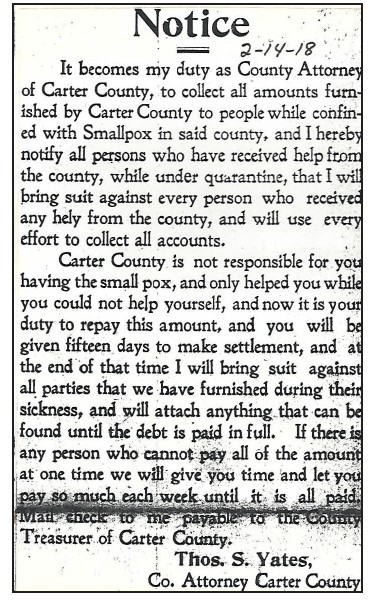
It also seems that issues with financing during these epidemics are nothing new. While many currently report having difficulty getting the unemployment benefits promised by the state, in 1918 the county was intent on getting back funds provided to those quarantined due to smallpox. Thomas Yates, then Carter County Attorney, published the following notice in large type in a February 14, 1918 paper; 

On the same day, the following was printed regarding the community of Olive Hill; 

So, it seems that the government stepping in and forcing public protection steps, be it vaccination for smallpox or face coverings for COVID-19, isn’t anything new. It also seems that folks expressed concerns about forced intervention, and whether or not acting earlier could have made a difference, then just as they do today. But, eventually, the illness passed and things returned to normal. Let’s all take the chance to learn from our history and do our parts – whether wearing masks or face shields, or social distancing – to help us get past COVID-19 as Carter County did to get past smallpox in 1918. 

Editor’s Note: This is the first in a series of articles drawn from the historical newspaper clippings in the scrapbooks of Jack Fultz. When necessary typographical errors and misspellings in the original have been corrected for clarity. We thank Sally James of Sally’s Flowers in Olive Hill for sharing her uncle’s collected clippings with us and the community. – Jeremy D. Wells, editor, Carter County Times

Late to the Game(s): Killing Floor 2, Lifeless Planet, the Escapists 2, and TrackMania available free now on Epic Games store

TrackMania is a family-friendly racing game rated E for everyone available free from the Epic Games store.

By Jeremy D. Wells
Carter County Times

If you’re interested in free games, and you haven’t been checking them out, you’re going to want to start looking at the Epic Games store every Thursday. Last week Epic Games only had one freebie title, Hue. Conan Exiles had been on that list, but dropped off for an unexplained reason. Maybe we’ll see it at a later date, maybe not. 

This week Epic seems intent on making up that disparity with three free games. Between now and July 16 you can pick up Killing Floor 2, Lifeless Planet: Premier Edition, and The Escapists 2 at no cost. Simply log-in to your Epic account (or create one) and add the games to your cart before checking out. The games will be available in your account to download after you install the Epic Games Launcher, if you haven’t already. 

Killing Floor 2 and The Escapists 2 are sequels, and should give you more of what you expect if you’ve played previous games in the series. The Killing Floor series are cooperative first-person shooters from TripWire Interactive where players face off against ZEDs, zombie-esque genetically manipulated “clones” with different abilities and mutations. 

The Escapists games are strategy escape games, played from a retro top-down perspective. Think Prison Break as a retro video game, and you get the idea. 

The game that really intrigues me, though, is Lifeless Planet. An astronaut on a mission to the eponymous lifeless planet finds an abandoned Soviet era settlement, leading to suspicions about the nature of his mission until he’s saved from some unnamed “strange and deadly phenomenon” by a “mysterious young woman.” At least, that’s what the game flavor description says. I haven’t played any of it yet, but I plan to as soon as possible. 

Based on game descriptions and video that I’ve seen it looks like a cross between your typical action-adventure game with the stark, abandoned environs and exploration/discovery of Everybody’s Gone to the Rapture, a game that I enjoyed immensely on PS4. If Lifeless Planet proves to be half as engaging as Everybody’s Gone to the Rapture, it’s going to be a fantastic experience, and with the low price of “free” you can’t really go wrong. 

Killing Floor 2 is rated M for Mature, while Lifeless Planet is rated T for Teen. Neither game in The Escapists series has an ESRB rating for the PC versions, but the original game has some of the expected prison violence, and The Escapists 2 is rated T for Teen in its PS4 incarnation, so the free PC version from the Epic Store is probably not suitable for younger gamers either. 

Family friendly choice 

If you are looking for a fun game to play with younger gamers, check out TrackMania Nations, from French publisher Ubisoft, also free on the Epic Games store as well as on the Steam store. TrackMania is an older game, with the version on the Steam store dating from 2008. But the version available on the Epic Store is the latest update, released in July of this year. Both versions feature a track editor, allowing you to design your own race tracks, as well as downloadable tracks. One of the neatest features is the “ghost racer” which allows you to test your time against the efforts of other racers who’ve already completed the course rather than against computer A.I. 

If you loved games like ExciteBike on the Nintendo Entertainment System growing up, as I did, you’ll enjoy the experience of TrackMania; especially sharing it with your kids, who won’t roll their eyes at the graphics experience the way they might at those classic console titles. 

TrackMania is rated E for Everybody, but online interactions are not rated, so – as always – you may want to monitor your children’s interactions if they are racing online. 

Killing Floor 2, Lifeless Planet, and The Escapists 2 all expire on Thursday, so if you want to claim them, do it today. Once claimed you can download the titles at any time by logging into your Epic Store account. 

Epic Store’s next free game, available after Thursday, is Torchlight II a top-down fantasy dungeon crawler. 

Contact the writer at editor@cartercountytimes.com 

Grayson Gallery & the blues on July 17

The Grayson Gallery & Art Center, Inc. (GGAC) will host the Huntington Blues Society, Inc., a 501c3 “for social-profit” corporation, for their annual Membership and Fundraising Drive on July 17 from 7- 9 p.m. Proceeds will also be used by the HBS to hold their annual Greater Huntington Blues Challenge for prize money and sponsorship of the winner for a trip to Memphis, TN for the International Blues Challenge. 

Another program which will benefit by funds raised will be the annual Diamond Teeth Mary Blues Festival in Huntington, WV. The HBS was established in 2013 and has been hosting an open jam for Blues musicians each month at only a few choice locations since that time. 

Cold drinks will be provided during the show and visitors may also pick up their own meal by patronizing one of the many eating establishments in Grayson and enjoy it during the show. Tables and chairs will be set up both inside and outside of the gallery space with all COVID 19 social distancing protocols followed. 

In addition to the music planned for the evening, the GGAC will also make the formal announcement of a recent grant award received from the Kentucky Foundation for Women (the Art Meets Activism Grant) which will fund workshops on songwriting, various instruments and the interesting history of women in music across Appalachia in the coming year. Karen Combs will be the Lead Artist and others across the region will be producing videos and recordings of various performances throughout the project. 

Director Dan Click said, “We have always enjoyed working with musician/music historian Karen Combs, the current HBS President, along with other officers and various members. Several of the organization’s member-musicians have participated in the Gallery’s monthly Second Saturday Shindigs in the past. In addition, a group of players headed up by Combs – The Appalachian Ladies Revue – was formed and performed during the annual ‘Women in the Arts’ event at the GGAC many times; they donate their contract fee to local womens & children’s charities.” 

“Personally (I’m sure I’m not alone in this) I’ve learned that the roots of the Blues and its players from the past have influenced much of what we know as rock as well as many other genres of music. Being able to promote ‘the’ Blues via the GGAC as its own unique genre truly appeals to those who love almost any kind of music!” 

The Huntington Blues Society hosts a radio show called the Diamond Duck Blues Hour each Monday at 3 p.m. on WMUL (88.1 FM) so be sure to tune in. Check out their Facebook page for more information. 

Contact Dan Click, Director, for other GGAC events and projects via email: graysonallery@gmail.com and look for them on their various Facebook pages

Returning to normal: As runs increase EMTs encountering more coronavirus cases

EMS director Rick Loperfido (right) and board president John Brooks (left) discuss EMS issues. (Photo by Jeremy D. Wells, Carter County Times)

By Jeremy D. Wells
Carter County Times

Carter County EMS executive director Rick Loperfido reported to the EMS board on Monday that, while the service was “still down about 300 runs” for the year to date, they have been “slammed” the last couple of days, an indication, he said, that numbers are beginning to return to normal. The service responded to 476 total calls for the month of June, with 343 of those considered billable calls. They had 321 transports, 98 refusals and 26 cancelled calls. Three of those calls were DOA, six were assists or standby calls, and 22 resulted in individuals who were treated and released.  

Numbers had been lower due to fewer people on the roads and participating in activities due to COVID-19 related sheltering in place. But as those numbers return to normal, and COVID-19 cases increase in the county (see “County reports first COVID-19 death” in this issue), EMTs are coming into more contact with individuals who may be infected with the virus. As a result Loperfido has set a requirement that all EMTs must wear N95 masks when responding to all calls. 

At the end of June, he said, the service “had only transported one known COVID case.” Since July 1, however, they have transported at least five known individuals who tested positive. One of those transported, who was taken to the hospital for unrelated symptoms and only later found to be positive for the virus, may have caused a crew to be exposed to the virus. While those two individuals could have continued to work, as long as they isolated from other coworkers and continuously wore N95 masks, they chose to take unused PTO time instead. They were scheduled for testing on Monday, Loperfido said, and if those results came back negative could return to work as early as today. 

He said that in addition to requiring staff to wear N95 masks during all transports now, they are also regularly disinfecting trucks between runs. 

Loperfido also reported that the service has received a $1,000 grant from the Foundation for the Tri-State, to be used in any way that benefits the service. Loperfido said the award came from the recommendation of Commercial Bank’s Mark Strother. He said that he is currently considering using the funds to get the helipad behind the Grayson station functional, and has priced striping lights and electrical wiring to run them. He requested an additional $500 from fiscal court to complete that project. (See “Libraries, grants, and trash” in this issue.) He told the board he had also spoken with Carter County Judge Executive Mike Malone about assistance in locating a spot in the Olive Hill area where a helipad could be constructed for that end of the county. That project, he said, would have a more significant cost because it would need to be completed “from scratch.” 

He said the service is also still in the running for an Assistance to Fire Fighters grant through FEMA, and that those funds – if awarded – could possibly be used to replace the county’s faulty O2 refill system. 

Loperfido also reported on repairs to vehicles, repairs to the hot water tank and other plumbing issues in the Grayson station, and a project to clean out storage buildings at the station. He said over 80 boxes of old records, including time sheets and run sheets dating back to the 1980s, had been removed and destroyed. Any records that were less than ten years old were retained. 

He also addressed employees off for worker’s compensation and said they were looking at some strategies to lessen the impact on EMT staff for dialysis transports, which should not require an EMT. 

The board moved to accept Loperfido’s report. 

In other action the board heard from John Clevenger with Griffith, DeLaney, Hillman & Lett on their audit of the service’s 2018 financial statements. Clevenger commended the staff for their help, saying they were “quite good” at their job and very helpful. While the audit showed the service was operating at a deficit in 2018, he said the audit “looks for fraud, errors and mistakes (and) we didn’t find any.” 

Valeria Nolan, who handles billing and finance for the service, noted that the 2018 audit reflected the period when the service went from a billing service to in-house billing. 

“Going forward from this one, it should look better,” Nolan said. 

But Clevenger noted that the pandemic will impact the services finances, if only because of the impact on business taxes. 

“Your revenue will be effected by this COVID-19,” Clevenger said. 

The board approved the audit, and moved to accept Nolan’s current financial report, before adjourning. 

Contact the writer at editor@cartercountytimes.com 

Finishing up the park: Park board discusses utility right-of-way and finishing work

By Jeremy D. Wells
Carter County Times

The COVID-19 pandemic may have shut down the tournaments that the Grayson Sports Park hoped to host if they had gotten to open this spring as originally planned, but it hasn’t stopped construction work on the park or park manager Grant Harper’s work to get the park ready for next year. The park board met last Thursday to discuss progress on the park, including utility right-of-ways, drainage pumps and plumbing, electrical work, and other finishing tasks to be done on fields and park buildings. 

Harper discussed the utility right-of-way at the opening of the meeting, noting that it was planned to be at least ten feet back from the park’s outside boundary. The outfield fence on the ball fields would be another 65 feet back from the utility right-of-way, he explained. The parks agreement on the boundary noted that a fence would be placed right on the outside border between the park and neighboring properties, with a privacy screen beyond that and no structures permitted within 50 feet of the fence. The board also discussed pumps to be used to handle drainage issues in the park, and differences between the pumps called for in the initial park plans and the pumps that will be used in lieu of those original pumps. The board noted there was no significant difference in functionality and that two pumps would be used alternately, to reduce wear-and-tear on the pumps and to help extend their individual life-spans, as well as to have an extra in reserve in case one of the pumps did fail. 

Park Board President Mindy Woods-Click discussed the parks budget, informing them that the park currently had $1.7 million in the account for the sports park. There had been an issue with some checks being released early, before tax collection had been taken in and deposited, which resulted in the account being overdrawn for a very short period of time. That issue has been rectified, however, and safeguards put in place to assure it won’t happen again. Board member Mark Strother also told the board that steps had been taken to reverse penalties on the account for the inadvertent overdraft. 

In other park progress Harper reported that Allard Excavation was continuing with “small leveling” around dugouts. He said the leveling being done in that area was “small, but tedious,” because it has to be done by hand since equipment can’t get into the area. But, he said, the park was nearly to grade. 

He also reported that J&K Electrical have a connection to finish, and once that was complete wiring of buildings and lighting could be completed. Then they would be “nearly done” with construction on the park. 

Plumbers have placed fixtures in the small buildings, including one of the concession buildings. They still have one concession building and one maintenance building to finish plumbing. 

All block work is complete on concession building number two, he noted, and next steps are to paint the building exterior and put the ceiling on the building. After that cabinets and other interior work could be completed. Cabinets have been placed in concession building number one, and counter tops and cabinets will be placed in concession building number two once the ceiling is on. 

 Harper also reported that fence posts are in for the dug outs, and they plan to have the out field posts up by the end of this month. 

“It might trickle into August,” Harper said, and interior work still needs to be completed on various buildings, but all exterior work has been done. 

His next steps will be to sow grass seed where he can, but there are some areas where he doesn’t want to sow grass until all the irrigation equipment – which is now partially installed – has been installed completely. He explained that dirt in the outfield is “so sandy” it won’t hold water, so it will need irrigation. The areas that are not currently seeded, or that have sparse grass, will be reseeded in the fall. Harper said that it is currently, “so hot,” and the field without available water, that any grass that took now would simply “burn up” before fall. After the weather cools and grows wetter he would seed again and fertilize existing grass. 

Harper also said that, rather than a zero turn mower, at this time he would be requesting a small tractor with a belly mower as his first equipment purchase. That would allow them to mow the grass on the fields as well as pull trailers and perform other tasks. 

In August, he said, they would put more gravel on the road, but that it would be limited. If the park waits until next spring for their final graveling, they will lose less gravel to the freeze/thaw cycle over winter. He said that he is also looking at concrete pull in and pull out areas, to further conserve gravel. He said that the pull in and pull out areas could be done mostly with the gravel originally intended for curbing around an island area that he didn’t feel was necessary at this time. The concrete pull in and pull out areas near the street would only lead to an approximate additional $5,000 in concrete costs, Harper estimated. 

The board had questions about keeping traffic from cutting through the park and keeping vehicles off the grass. Harper said that gates could be used to keep traffic from using the park as a drive-through area, or to keep it from being used as a drop-off point for the middle school. As for ATV traffic, he said fences around the playing fields should be sufficient to keep ATVs off the playing surface grass. With curbs, he said, they should be able to keep most other vehicle traffic out, but there is nothing that they can do to keep foot traffic out. 

Former Grayson city councilman and park board member Duane Suttles said that traffic lights at the ambulance end of the park wouldn’t be necessary. While a traffic light may be needed on the front end of the road eventually, Suttles said, it wouldn’t be necessary for the ambulance end. 

“This is why they have lights and sirens,” Suttles said. 

They will have to address the helipad again eventually, Suttles said, because they can’t have any vehicles parked near the helicopter. 

Woods-Click said that paperwork with AEP has been signed, and they should be coming out soon to turn power on. She also noted that she talked with AEP about KY Power Economic Growth Grants. These are rolling grants with no deadline. She said they going to address the grants from an economic growth perspective. While the park will not be creating any more jobs directly, it will impact other businesses in both the Grayson and surrounding communities. 

 “AEP felt positive we would get something,” Harper added. 

He said the park has also discussed other grant opportunities with FIVCO. 

New city councilman and park board representative for the city Jerry Yates said he had been contacted about weeds on the park lot, and around buildings like the field office. 

“I understand. I do construction,” Yates said. But, he added, because of the city’s weed ordinance, he has been getting push back from constituents who want the park property to be more maintained while construction is ongoing. 

Harper said he was already talking with someone about weed eating around the park. 

Harper also said he is “exploring options” for office space once the park is finished. He is also talking with different companies about equipment for the park’s spray ground play area, park playground equipment, and coverings for the amphitheater. He said a seasonal fabric covering or canopy would likely be the most economical route for the amphitheater. While it would not be rated for a snow load, and would have to be taken down in the winter, it was rated for wind and would be about half the price of a hard or solid cover. He said he was also looking at pricing for different tiers of spray ground and playground equipment. 

While the spray ground is unlikely to open until next year, Woods-Click said the community, “would like to see some playground equipment this fall.”  

Contact the writer at editor@cartercountytimes.com

Libraries, grants, and trash

Fiscal court issues run the gamut at Monday meeting

By Jeremy D. Wells
Carter County Times

Carter County Fiscal Court handled a mixed bag of issues on Monday night, but, as always, roads were a central component. 

George Tomlin addressed the court during the public comment period, asking for a road leading to a family cemetery plot to be renamed. The road is currently known as Seagraves Hollow on maps, Tomlin explained, but everyone knows the road as Tomlin Hollow. Tomlin, who owns a home on the road and whose daughter and son-in-law are building a home on the road, said he would like the official name of the road changed to reflect the popular name of the road. Judge Executive Mike Malone said if there was no conflict with the name, he saw no issues with changing it. He asked E911 coordinator Joe Lambert to work with magistrates to measure the distance of the road and to change the name of the road in E911 mapping software. 

Lambert also updated the court on progress with 911 mapping. The county must be in compliance with a new generation of 911 software next year, Lambert explained, and the county’s E911 service have secured a $50,000 Map Grant Award that will help the county update their mapping to meet those new requirements. The funds will be used to conduct an audit on all mapping and addresses, he explained, “to make sure everything is where it is supposed to be.” As Lambert noted in the meeting, and has noted previously, while the current mapping and GPS coordinates are generally sufficient for getting first responders to the correct location, they aren’t accurate down to the exact foot. This new system will make sure the GPS coordinates associated with addresses are accurate to a higher degree. 

Road department supervisor Jason Carroll updated the court on a new cold-mix asphalt system that the county is going to experiment with. While traditional asphalt mixes need to be held hot while they are used, this new system – which Carroll said takes five days to cure completely – can be held for several days if work is interrupted by foul weather such as rain because it doesn’t harden immediately. Otherwise, he explained, it is used exactly as traditional asphalt mixtures. 

“You roll it just like asphalt,” he said. 

Because of the oil used in the mix, sand or fine gravel does need to be placed over the mix, so that it can absorb the oil to keep it from fouling automobiles until the road is cured. The new cold-mix is less than half the price of traditional asphalt as well. Carroll said twelve gallons of the oil mixture can treat up to a ton of gravel. 

In other action, the court moved to approve a request from new Carter County Librarian Christy Boggs to continue their share of funding for the Carter County Public Library. Boggs mentioned the different services the library provides for citizens of Carter County in addition to the traditional book lending services, which they have been keeping up with via curb delivery while closed to visitation during the COVID-19 pandemic. Those services, which reopen today, include internet service and computer access for research, work and educational purposes. The county approved Boggs’ request to fund the library for $6,250 each fiscal quarter, for a yearly total of $25,000. 

The court also heard department reports from Carter County Jailer R.W. Boggs and Sheriff Jeff May. 

Boggs reported that the jail was down 70 billable inmates due to the COVID-19 outbreak. This was due to some state inmates being removed from the jail and no new state inmates being placed in the jail, which leaves them to regrow that population of billable state inmates through the transition of local arrests to state inmates when their cases are converted to state courts. Boggs said the original COVID patients were set to be tested again on Tuesday. He said all jail staff, including himself, have also been tested for the virus via nasal swab, an experience he described as “horrible.” 

May provided the court with his monthly report for June. During the previous month his office served 31 processes, attempted 58 processes, and served 10 warrants. They also made 21 arrests, issued 14 citations, made 43 traffic stops, and responded to 31 accidents. Deputies assisted motorists 34 times during the month. They responded to 12 domestic situations, 10 drug and alcohol related issues, 13 theft complaints, and assisted other agencies nine times. Other complaints totaled 207. There were no prisoner transports for the month. The department completed 146 vehicle inspections. May himself was contacted 617 times, bringing the total number of contacts for the department in June to 1,256.

The court also adopted a resolution authorizing the judge executive’s office to file for reimbursement under the CARES Act. The maximum the county could be reimbursed under the COVID related act for improvements meant to safeguard the public and county employees is $900,000. 

Another resolution was passed authorizing the Rattlesnake Ridge Water District to apply for a Civic Development Block Grant meant to replace water lines placed during project phase one of the Rattlesnake Ridge project. The district is currently on project twelve, and some lines installed during the first project, over 30 years ago, are beginning to fail, Malone explained, leading to the district “losing an unacceptably high percentage of water.” 

The court also moved to make the pews currently used for seating in the fiscal court room surplus. Malone said he would like to remove the pews and replace them with individual seating, which could be spaced further apart to conform to social distancing guidelines. Magistrates also approved Malone’s request to remove the judges box and level the floor in the back of the courtroom, noting that it is no longer necessary as the court hasn’t been used as a legal courtroom since the 1970s. This will allow the court to move their tables further back, and add to the seating area for the public. 

In further public safety related issues the court approved a request to fund half of an IPAWS project, splitting the $1000 yearly cost with the city of Grayson. The Integrated Public Alert & Warning System (IPAWS) allows the city to send an automated message to all telephones in Carter County in the event of a public emergency situation. All messages sent through the system must be approved by the Federal Emergency Management Agency (FEMA). 

The court didn’t immediately approve a request from county EMS to pay an additional $500 for a helipad project near the EMS office that will be partially covered by a $1000 grant, but did agree to take the request under consideration. The project would stripe and light the helipad for night time use. They also agreed to look at other locations in the Olive Hill area for a similar helipad project on that end of the county.

E911 coordinator Joe Lambert said that the county has 20 designated landing zones, but that none of the other landing locations have pads with lines or lighting. 

In solid waste related news the court discussed possible solutions for reopening county dumpster drop-offs, including creating a “click-list” style online scheduling system. Magistrates reported that request for the return of dumpster drop-off for large trash items were among the most requested services from their constituents.

Finally, the court approved the appointment of former state legislator Jill York to the county ethics board.  

Contact the writer at editor@cartercountytimes.com


New Carter County Librarian Christy Ann Boggs secured the county’s financial support for the library at their regular meeting on Monday night. (Photo by Jeremy D. Wells, Carter County Times)

Connie J. Knell Leadingham

1975-2020

Mrs. Connie J. Knell Leadingham, age 44, of Goose Creek Road, Olive Hill, Kentucky, passed away Sunday, July 12, 2020, at her residence. 

She was born November 24, 1975, in Fayette County, Kentucky, a daughter of the late James and Ida Smith Knell. 

Connie was a member of the Old Path Pentecostal Holiness Church and she loved going to church, gardening, being outdoors, fishing, helping others and spending time with her family and friends. 

In addition to her parents, she was preceded in death by three brothers, James Cornell, Johnny Knell, and Timothy Knell. 

Connie is survived by her husband of 6 years, Nick Leadingham; two sons, Jesse Smith (Melissa) of Carter City, Kentucky, and Nicholas Leadingham Jr. of Olive Hill, Kentucky; two daughters, Brittany Lee (Danny) of Carter City, Kentucky, and Emily Smith of Olive Hill, Kentucky; five grandchildren, Alivia Gifford, Braylon Smith, Jaxon Lee, Chanston Lee and Adalynn Smith; one brother, Phillip Knell of Vanceburg, Kentucky; and two sisters, Iona Thomas and Doris Thomas, both of Vanceburg, Kentucky. She also leaves many other family members and friends who will sadly miss her. 

Funeral services will be held at 11 a.m. Wednesday, July 15, 2020, at Globe Family Funeral Chapel in Camp Dix, Kentucky, with Brother Daniel Miller officiating. Burial will follow in the Lee Cemetery on Halfway Branch in Carter County, Kentucky. 

Friends may visit from 6 p.m. to 8 p.m. Tuesday, July 14, 2020, and after 9 a.m. on Wednesday at Globe Family Funeral Chapel, 7975 Lower Kinney Road, Vanceburg, Kentucky 41179. 

Danny Lee, Eric Johnson, Larry Stacy, Tyler Leadingham, J.J. Smith, Kevin Burton and Cody Knipp will serve as pallbearers. 

Due to COVID-19 regulations we ask that everyone wear a mask and practice social distancing. 

Condolences may be sent to the family at http://www.globefc.com.

Op-Ed: How sportsmen and women continue to set an example in the age of social distancing

By: Senator Robin L. Webb

FRANKFORT — The COVID-19 pandemic has ushered in many changes to which we must all adjust. Phrases like “self-quarantine” and “social distancing,” rarely used or completely unheard of several months ago, are now a part of our daily vocabulary. As we adjust to this “new normal,” America’s sportsmen and women, a group that I am proud to serve as Co-Chair of the Kentucky Legislative Sportsmen’s Caucus, have found a way to pursue their outdoor passions while much of the world seemingly stood still. By participating in outdoor activities like hunting, fishing, and recreational shooting, sportsmen and women are setting an example for those looking for safe and responsible recreational opportunities.

While millions of Americans have been forced to limit their travels due to mandatory stay-at-home orders, activities like hunting, fishing, recreational shooting, and many other outdoor activities have provided an outlet for Americans to safely recreate as they can be enjoyed while practicing social distancing and adhering to other COVID-19 safety guidelines. As restrictions start to ease, Americans are flocking to the woods, waters, fields, and trails to take advantage of our outdoor resources, with many discovering nature’s wonders for the first time.

This newfound interest in outdoor recreation represents an invaluable opportunity to introduce American’s to activities like hunting and fishing and the vital role sportsmen and women play in conservation. In addition to the numerous documented mental and physical health benefits gained through these activities, maintaining access to hunting and fishing opportunities gives Americans a chance to procure their own locally-sourced meat. Due to many of the impacts of COVID-19, this ability to be self-reliant is at a premium. With all of this in mind, these unprecedented times represent a chance for a new generation of sportsmen and women to discover the passion that many of us already share. Be it through scouting for upcoming fall hunting seasons, or landing that first largemouth bass, now is the time to lead by example and plant the seeds for the next generation of sportsmen and women.

Increased participation in hunting, fishing, and recreational shooting has enormous conservation benefits as well through the American System of Conservation Funding. This “user pays-public benefits” approach relies on the sale of hunting and fishing licenses and self-imposed excise taxes on firearms, ammunition, archery equipment, fishing tackle, and motorboat fuel to fund many state fish and wildlife management agencies. In addition, these activities support local economies which, during these unprecedented times, has become incredibly important. In fact, recent surveys report that Kentucky’s 713,000 hunters and anglers spent $1.9 billion while pursuing their outdoor passions.

Unfortunately, the ability of America’s sportsmen and women to participate in their outdoor endeavors were not uniformly protected as statewide orders were announced. In fact, several states saw actions that hindered or even eliminated the ability to participate in our treasured outdoor traditions. While largely enacted in an effort to prevent the spread of COVID-19, these actions severely limited our outdoor opportunities without any measurable increase in public safety. To ensure that such restrictive actions are not used again, it is up to sportsmen and women to practice responsible recreation, showing by example that our outdoor pursuits can be performed safely. This can be accomplished by following a few simple guidelines:

  • Plan ahead; purchase licenses and park passes online, if available.
  • Recreate close to home
  • Adhere to best practices for avoiding COVID-19
  • Follow state and federal guidelines
  • Pack out your trash as a courtesy to others and to avoid the appearance of overuse
  • Share your adventures in a respectful way on social outlets

To learn more about how others are using these challenging times as an opportunity to spend more time outdoors, search for #ResponsibleRecreation on social media. Likewise, for more information on recreating responsibly, or to take the Responsible Recreation pledge and help lead by example, visit http://www.responsible-recreation.org.

As always, you can stay in contact in the following ways:

  • To leave a message for any legislator, call the General Assembly’s toll-free Message Line at 1-800-372-7181. People with hearing difficulties may leave messages for lawmakers by calling the Kentucky Relay Service at 711.
  • You can write any legislator by sending a letter with the lawmaker’s name to Capitol Annex, 702 Capital Avenue, Frankfort, Kentucky 40601-3448.
  • You can also email me directly at Robin.Webb@LRC.KY.GOV.

Wolfpack opens strong and finishes undefeated

Logan Rice (20) hits the baseball to the right side to advance the Wolfpack runner.

Grayson team dominates 12 and under tournament

By: Mason Branham
for the Carter County Times

WORTHINGTON – The Russell River Cats had more hits, but they surrendered too many free passes in the first two innings Friday, July 3, and lost to the Grayson Wolfpack, 8-3, in the opening game of the Back to Baseball Tournament for 12 and under teams. 

The River Cats collected seven hits in the game, which was stopped at the end of four innings due to the time limit. Three of the River Cats’ hits went for two bases. 

The Wolfpack managed just three hits, but they were all in the opening two frames. Russell pitchers walked six and hit a batter in those two innings. They also uncorked three wild pitches. 

The Wolfpack’s Sawyer Hatfield doubled to open the game. The next two batters were walked. All three scored on wild pitches. 

Winning pitcher Landon Yoak and Parker Fouch singled to start the Wolf Pack second inning.

The next four batters walked or were hit by a pitch. Three runs scored. A sacrifice fly by Jay Timberlake drove in another run for a 7-1 lead. 

Back-to-back Russell errors led to the final Grayson tally in the fourth. 

Caden Mitchell walked to open the River Cats’ half of the first inning. Following a double by Jacob Tolliver, Mitchell scored on a wild pitch. 

However, Tolliver was retired trying to score on a pitch that went to the backstop. Tolliver was the first of two River Cats runners cut down at the plate. 

Russell had a walk and a double by Brady Boggs in the second inning, but failed to score. 

Criswell singled with two out in the Russell third stanza. He moved to third base on Keoni Ancheta’s ground rule double. 

Alex Harr singled home Criswell, but Ancheta was thrown out as he tried to score from second base. 

Boggs singled for his second hit of the game. After stealing second and third bases, he came home on a wild pitch.

Championship 

The Wolfpack finished the tournament undefeated when they took the win over host Raceland, 11-1, Sunday to wrap up the championship. 

Colton McGuire tossed a two-hitter for the Wolfpack. 

Wolfpack started the game bunting. Lead-off batter Sawyer Hatfield beat out a bunt for a hit. Logan Rice sacrificed Hatfield to second base and was safe on an error. 

Grant McComas and Jay Timberlake reached on errors with two runs scoring. Van Green drove in the third run of the inning with a ground out. 

McGuire retired the first five Rambler batters he faced before Jackson Winters picked up a bad-hop single. 

The Ramblers cut the lead to 3-1 in the top of the third inning. Aiden Shaffer walked to open the stanza. Then moved around the bases with a steal, passed ball and wild pitch. 

Sam Lynd also walked later in the inning, but was stranded at second base. 

The first two Wolfpack hitters reached base on errors in the bottom of the frame. An error and a stolen base put Rice at second base. He scored when McComas again reached base as the result of a Rambler error. 

Jay Timberlake singled home the second run of the inning. Tyler Cordial followed with a hit. 

Van Green walked to load the bases. 

McGuire helped his own cause with a two-run single. 

A ground out by Trevor Layne made the score, 8-1. 

Hatfield’s second hit drove home McGuire with the sixth run of the inning. 

Braden King opened the Raceland fourth inning with a clean hit. He swiped second and third bases, but was stranded as McGuire struck out the final two Raceland batters of the inning. 

The first four Wolfpack batters in the fourth inning reached base with two scoring to end the game. 

Timberlake opened the inning with his second hit of the game. Gunner Hignite walked. Caleb Hall’s hit drove home a run. 

McGuire ended the game with his second hit. He drove home three runs in the game.

As we see it: Saying “No” to tobacco

Last year the Kentucky legislature passed HB 11, a “statewide Tobacco Free School bill.” This year the Carter County public school system will be taking steps to comply with that bill. 

This means no more tobacco of any sort on any Carter County school campus. No cigarettes. No snuff. No chewing tobacco. No vaping. Nada. Zip. 

Staff won’t be allowed to smoke in their vehicles in the parking lot before or after school. Visitors to the schools will also be asked not to bring any tobacco products with them, or to use tobacco in school parking lots or anywhere on school property. 

This also extends to any chaperones accompanying students on school-sponsored overnight trips. Band parents, football and basketball boosters, the mothers of cheerleaders, and any other adult working with students will be asked to refrain from any and all tobacco use for the duration of the trip. 

We know that, for some, this is going to be a tough sale. Kentucky is historically a tobacco producing state. Many of us earned extra cash as teenagers working in the tobacco fields. And tobacco, as a cash crop, is still important to many Kentuckians, even if it’s less important to the state economy as a whole than it once was. 

Along with this tobacco culture, though, came a lax attitude about youthful tobacco use. For years Kentuckians had no minimum age for tobacco purchase. It wasn’t until 1990 that the state set a minimum age of 16 for tobacco purchases. In 1992 that legal age was raised to 18, though many outlets continued to turn a blind eye to underage tobacco purchases and use. The 18 limit has stayed in place since, but in January of this year a bill that would raise the age to 21 passed out of committee into the Kentucky Senate. It remains to be seen what will happen with this bill. 

Past bills seeking to raise the age for tobacco and nicotine product use have been stymied by tobacco friendly legislators. But despite this, concerns about youthful smoking, chewing, and, particularly, vaping have grown. 

Those critical of youth vaping often criticize the fruity and other “sweet” flavors that vaping juice concoctions regularly have. They seem designed specifically to appeal to youth consumers. If this sounds familiar, it’s because it is. The FDA took action to ban flavored cigarettes in 2009, partially because of their supposed appeal to youth consumers. (Many producers got around this ban, however, by changing their “cigarettes” to “mini cigars” or “cigarillos.”) 

As an adult, it may be frustrating to find that you can’t find a product that you want to use. It may also be frustrating to find that you can’t use those products, even in the privacy of your own vehicle – or outside on a hotel balcony – when engaged in a school related activity. We understand this frustration. After all, adults can make informed decisions about what to put into their bodies. 

Children, however, even the brightest children, can’t make those same informed decisions. Peer pressure, social pressure, and media and entertainment sources all make an oversized impact on the choices of our youth, and they need to see good modeling if we expect them to follow it. 

It may frustrate adult tobacco users, but our children need them to be positive role models. When they hear teachers tell them to avoid tobacco use, and then see those teachers and other adults in their lives using tobacco in their automobiles, or outside a restaurant on a school trip, it sends mixed messages. If we want our kids to make the choices that are best for their health, and their future, we need to be the adults. We need to make that sacrifice for their benefit. 

It may not be what we want to do. It may not be easy for us to do. But it’s necessary. And now it’s the rule when you go on school property. 

We commend the Carter County public school system for following the recommendations of the state legislature, and ensuring that teachers, principals and chaperones will be providing a good example when engaged in school business or on school property. When our kids grow up without the breathing problems and lip, throat, and lung cancer that accompany tobacco use, we think they’ll thank them too. 

Deputies test positive for COVID-19: Boggs says jail following procedures to keep inmates safe

By Jeremy D. Wells
Carter County Times

 Carter County Health Department director Jeff Barker updated the county’s COVID-19 numbers last Thursday to include two new cases, bringing the county’s total number of infected at that time to 33. Of those 22 had already recovered, 10 were isolating at home, and only one was hospitalized – though by July 4 those numbers had been adjusted to 22 recovered and 11 still isolating at home as the single hospitalized individual had been released to recover at home. 

On Sunday another seven cases were added to those numbers, the largest single day jump in Carter County since testing began, Barker said. An eighth was added on Monday. This brought the total number of positive cases in the county to 41, with 22 recovered and 19 still isolating in place. 

Although Barker and the health department do not release the names of those infected, in compliance with HIPAA regulations, Carter County Jailer R.W. Boggs confirmed that two of the recent cases were deputy jailers. Those two deputies were diagnosed separately. Another seven were from one of the female units within the Carter County Jail. Boggs said all nine inmates still held in that unit had been tested, and the two who tested negative were moved out and isolated. The other seven who tested positive were still isolating in place and nearing the end of their fourteenth day since exposure on Monday, he said, and all had exhibited very mild symptoms. Nevertheless, they were quarantined and would remain so until it was deemed safe to resume contact with other inmates. He also said the jail was continuing to take recommended precautions to keep staff and inmates safe. 

“We’re testing more inmates and deputies (and) still following state guidelines,” Boggs said. “The worst part about it is what gets it inside a jail is non-symptomatic individuals.” 

Boggs said they still weren’t allowing visitors to enter the jail as part of their efforts to prevent further outbreak among inmates. In addition to that, all deputies and other jail staff are required to wear masks. He said other efforts to keep the jail coronavirus free included temperature checks and “constant cleaning.” 

Contact the writer at editor@cartercountytimes.com

Gifts, clothing, furniture, and more

 Jean Marie’s Boutique offers class (and sass) on a budget

By Jeremy D. Wells
Carter County Times

 Jean Marie’s Boutique is a dream come true for Bonnie Barker and her mother, Debbie Jenkins. The duo have wanted to start their own business for a while, and the end result of that dream – named for Barker’s grandmother – tries to offer a little bit of something for everyone, from casual clothing to fancier fare, and from gift items and books to home decor. 

“It’s something we’ve kind of always wanted to do is start our own business, but we never really had the funding to do it,” explained Barker. “But we kind of decided to just go ahead and take the plunge and do it, and so far it’s been going really well. Trying to just offer a variety of things to people at a lower price.” 

They held their ribbon cutting and grand opening last Wednesday, and in that time they’ve already sold out several of the clothing items, and had to place two more replacement orders. 

“We’ve already had to order new clothes,” Barker said. 

She said the gift side of things, particularly bereavement gifts, have also gone well. 

“Word’s gotten out about our bereavement gifts. We hate that it happens, but we’ve been able to deliver several of those already,” she said. 

They offer free delivery of bereavement gifts to funeral homes in the Olive Hill area, and will deliver to Grayson and Morehead as well for a small fee. 

They also sell “unique furniture pieces” and other home decor items. Many of the furniture pieces are designed and built by Barker’s husband, or refinished and updated by him from pieces that are found at flea markets, auctions and estate sales. They’ve already sold many of the pieces that are currently on display in the store, but hope to have new items soon. 

“We’re focusing on unique furniture pieces, redoing all of those, and we hope to expand every aspect in the store,” she said. 

“We plan on having some one-of-a-kind things,” she said of her husband’s furniture building. “He’s working on some Kentucky signs right now. There’s really nothing else like it in Olive Hill, to just stop in if you need a coffee mug or a candle for a quick gift.” 

On the clothing end of things, she noted that they “got a little bit of a lot of different sizes,” but based on customer feedback so far they are looking at adding more dress type clothing, of the type that would be appropriate for church or work wear, and also looking at adding more plus-size items as well. 

If it seems eclectic, it is, but the inspiration for the store comes from its namesake, Jean Marie. 

“My grandmother’s name was Bonnie Jean Marie,” Barker explained. “She was kind of the hero in the family. Kind of kept us all together. So when we were thinking of a name, we were brainstorming back and forth, and when we said Jean Marie’s it was just, that was it. And she was kind of classy on a budget, and that’s kind of what we modeled the store after.” 

“There’s a picture of her there,” Barker said, indicating a young lady in a black and white photo, teasingly showing off a bit of her knee beneath a stylish patterned dress. “As you can tell she’s a little classy and sassy.” 

Contact the writer at editor@cartercountytimes.com 

We old soldiers should be proud of our service

By: Keith Kappes
Columnist
Carter County Times

I put a new sticker on the rear windshield of my almost new car. It shows the U.S. Army logo over these words: 

“Soldier For Life”. 

To me, it says I will always be proud of my time in the uniform of my country and that I will forever be a loyal supporter of the Army and other military branches. 

I realize there are millions of veterans who gave much more than me. I never saw combat. I never fired a shot in anger. I briefly served overseas but not during wartime. 

My 22+ years of volunteer service included the Army, Army Reserve and Kentucky Army National Guard. As a Guardsman on state active duty, I responded to floods, blizzards, tornadoes, fires and other civil emergencies. 

I have never sought medical help, G.I. Bill benefits or other assistance from the VA because those resources should go only to those vets who can’t afford to pay. 

I am a proud member of Corbie Ellington Post 126 of the American Legion. The Legion’s motto is very meaningful to me, “Serving God and Country since 1919”. 

The American flag is displayed at my home on national holidays and other special occasions. What I know about flag etiquette I learned as a soldier. That is also true about my experience with firearms. 

My limited driving experience with big trucks and heavy equipment came from the Army. The Army also gave me the first opportunity to shave every day and shine my footwear. 

What little I know about feeding large numbers of people and cleaning up after them I learned while serving as an Army mess sergeant. That skill has adapted well to family reunions, church outings and helping my wife raise eight kids. 

Yep, at 77, I’m proud as hell to be an old soldier.

Keith Kappes can be reached at keithkappes@gmail.com

Betty Jean Hall Logan

1934 – 2020

Mrs. Betty Jean Hall Logan, age 73, of Olive Hill, Kentucky, entered into rest Thursday, July 2, 2020, at her residence. 

She was born March 22, 1947, in Carter County, Kentucky, the daughter of the late Walter and Goldie Tabor Hall. 

Betty was a member of the Flat Fork Church of God and enjoyed going to church, gardening, flowers and especially loved spending time with her family. 

In addition to her parents, she was preceded in death by her loving husband of 41 years, John William Logan and two brothers, William L. Hall and Chester Arthur Hall. 

Betty is survived by five sons, James Darrell Fultz (Jeannie) and Chris Fultz (Kim) all of Olive Hill, Kentucky, Samuel Rayburn of Louisville, Kentucky and William Logan (Connie) of Olive Hill, Kentucky and John Eric Logan of Morehead, Kentucky; three daughters, Mary Rayburn (Darby) of Olive Hill, Kentucky, Pamela Logan (Mike Leadingham) and Tammy McClurg (Todd) all of Morehead, Kentucky; 14 grandchildren; 15 great grandchildren; and two brothers, Logan F. Hall “Jr.” and Sable Lesley Hall both of Farmers, Kentucky. She also leaves many other family members and friends who will sadly mourn her passing. 

Funeral services will be held at 11 a.m. Tuesday, July 7, 2020 at Globe Funeral Chapel in Olive Hill, Kentucky, with Brother Ronald Logan and Brother Steve Madden officiating. Burial will follow in the Upper Flat Fork Church Cemetery in Carter County, Kentucky. 

Friends may visit from 6 p.m. to 9 p.m. Monday, July 6, 2020, and after 9 a.m. on Tuesday, at Globe Funeral Chapel, 17277 West US Highway 60, Olive Hill, Kentucky 41164. 

Greg Kiser, Robert Hall, Brandon Wells, Anthony Fultz, Sean Wells, Lesley Hall and Christopher Fultz will serve as pallbearers. 

Condolences may be sent to the family at Globe Funeral Chapel.

Living in the future

By Jeremy D. Wells
Carter County Times

When I was a kid I had this series of books about what life would be like in “the future.” While not all of it has come to pass, so much has that it is almost spooky at times. It’s also interesting how much of it has happened in a different way than predicted in those books. Let’s take communication technology, for instance. 

In those books the telephones we all had mounted to our walls in the 1980s were replaced with giant screens for video calls. That still hasn’t happened in the way the books predicted, but video conferencing is now a big part of all our lives. From Facetime on iPhones to Skype, GoToMeeting, and Zoom on our laptops, tablets and smartphones, teleconferencing is firmly embedded in our lives – particularly our business lives. Video phones never have replaced the land line or the standard cell phone, probably because we still don’t want to answer every call with our faces visible (no one wants to have to get up and put on real clothes and makeup, or to shave, just in case we get a telephone call), but it’s an option that many of us take advantage of at least every once in a while. Whether to show off the new baby to snowbird grandparents in Florida, or to hold a business meeting while quarantined due to a pandemic – or just to stay involved while out of town for work or on vacation – it’s a ubiquitous part of modern culture. 

Another thing that was predicted was something that every gamer is familiar with, and probably takes for granted; playing games online. Granted, in that age of the Atari 2600 and Colecovision, the kind of distance gaming discussed took the form of holographic board games like chess or checkers played with “friends from around the world” instead of the online first-person shooters and MMORPGs that dominate online gaming today. But still, they were right. Online gaming is a huge part of the modern landscape. 

My favorite part of living in the future, though, might be the household robots that were predicted. These have pretty much manifested exactly as predicted in the books. Our Roomba vacuum cleaner (we call him Bob) and our Braava mop (we call her Rosie, after the robot housekeeper in the Jetsons) make life so much easier that I’d hate to go back to living without them. One thing I would love, though, is the type of household integration shown in these books. Bob and Rosie require external plugs and charging stations, while their counterparts in these childhood books stored away inside the walls when not in use, behind tiny automated doors. I really wish that was the way they worked for us. It isn’t just for aesthetic purposes. We have a toddler, and he absolutely loves to push their buttons. This means the vacuum or mop starting outside their scheduled time, as well as a continuous on/off of the machines while he gleefully pounds on them. 

So, the future isn’t exactly perfect. I have to keep the kid from tearing up the robots. And I still have to weed eat around the house and swing set too. But letting Yard Bob, our robot lawn mower, run continuously between charges while I sit on the patio watching the kids play sure as heck beats pushing a gas powered mower in the summer heat. Viva life in the future! 

Jeremy D. Wells can be reached at editor@cartercountytimes.com