Home Blog Page 287

Huntington Blues Society at the Grayson Gallery & Art Center

Christian Couture: Trinity Sisters’ Design brings faith based creations to Olive Hill

By Jeremy D. Wells
Carter County Times

Christy Nolen Stamper has had passion for design for a long time.

“I have always had an interest (in design),” Stamper explained. “I’ve always been really, really crafty. All through high school and stuff I was always in art class – doing this, doing that. Then as I got older I was like, ‘Wait a minute? I can do something to make a profit!’ So, back in 2018 I was pregnant and me and my husband decided, let’s just go ahead and start. Try this thing out. So we went out and started purchasing the equipment. I started working from home and doing it from there so I could stay home and not have to return to the orthodontics office I was working at.”

If Stamper had always had an interest and passion for art and design, moving to make it her career caused her to fall deeply and madly in love with it.

“I loved it,” she said of her new work. She set up an etsy shop (www.etsy.com/shop/TrinitySistersDesign), and began pushing her work through social media.

“Then I was selling stuff on Facebook. It started from there and then came to this,” she said, gesturing around at the shop, located in a refurbished dry cleaners shop on Railroad Street in downtown Olive Hill.

“The help of friends and family is actually what’s made this what it is,” Stamper said. “We had to completely strip (the building) out. There were walls up that we had to take out. We took all of the (dry cleaning) equipment out that was in here… Then started from scratch.”

The design of the shop takes advantage of the building’s innate charm, though, with areas of exposed brick and original plaster kept on some walls.

“We wanted to keep some of the original stuff to the building,” Stamper said. “You know, some of the walls and stuff, yeah, they’re a little bit rustic, but we kind of liked that feeling.”

The name of the business, Trinity Sisters’ Design, reflects the close relationship between the three sisters and their faith.

“We’re three sisters,” Stamper said. “And we’re really, really close and wanted to keep everything together. So when we talked about doing this I told them, ‘We need something that represents the three of us.’ We’re real big into church and stuff, so I told the girls, ‘There’s three of us, let’s do Trinity,’ then with us being sisters and design, it just fell into place.”

That faith is reflected in some of the original designs on t-shirts in the shop, such as the mustard yellow shirt with a quote about having “faith the size of a mustard seed” from the book of Matthew, and another with the commandment to “love one another” taken from the book of John. Others reflect the busy life of a mother, something Stamper knows well as the mother of a toddler. These original designs, and others, are mixed in with boutique offerings and other items.

The sisters – Christy Nolen Stamper, Ashley Nolen Johnson, and Brooke Nolen – held their ribbon cutting and grand opening on Saturday. The shop, located at 420 Railroad Street in Olive Hill, is open from 9 – 5 Monday – Friday and 9 – 2 on Saturday.

Contact the writer at editor@cartercountytimes.com

As we see it: Library funding important for communities

In today’s world of streaming video, music on-demand, online gaming, and electronic books you can read or listen to on your phone, tablet, or other device, printed books you borrow from the library can seem almost quaint. Sure, there are still plenty of bibliophiles who prefer a book they can hold in their hand, but you could be forgiven if you prefer to consume media digitally. Some might say that, in such a world, the value of a library is limited. 

Those people, however, would be wrong. The role of the library in our communities is still as important as it ever was. In some ways, it may be even more important. Far from being a simple repository for paper books, the modern library – and the modern library patron – reflect these same changes in how people consume media. Along with printed books the modern library offers audio books, films, and even video games for their patrons to borrow. With your library card you can even borrow electronic books, digital audio books and streaming films through phone and computer apps like OverDrive. But the library is more than this too. 

The primary role of the library is, and always has been, to serve as a window into and a portal to the larger world around us. Particularly in rural areas, like Carter County, the library serves as a place where those without home internet access, or even a home computer, can go to access those resources. The library allows those without a high school diploma to obtain an education. It allows those looking for a job to apply for one, particularly in a world where online job applications are increasingly the norm. If a job requires a printed application, résumé or other documents, they can use library resources to build and print those. If a remote job requires someone to submit payroll or mileage online, the library is there to help with that task too – ensuring that truck drivers and contractors without adequate access to the internet, either while on the road or at home, can get paid and feed their families. 

More than that, though, the library serves as a social hub for a community. Library space can be used for job interviews, for business meetings, and for clubs and other community groups to meet. The Carter County Public Library has provided space for poetry readings by local author George Eklund. They provide a regular meeting space for school based gaming clubs, like the group that teaches math, social studies and literature through tabletop role playing games. They have also provided meeting space for local writers group Beyond the Forest, space for volunteers working with Maysville artist Ken Swison to put together art and literature magazines, and many, many other groups and organizations. 

The roles the library fills in our communities is important, and they could do so much more if they were adequately funded. Unfortunately, though, they are not. Former Governor Matt Bevin cut state funding to libraries during his tenure, putting many rural libraries at risk. Former library director Nellie Middleton took a cut in salary during her last year with the library to keep it going after state funds were cut, and the library’s new director, Christy Boggs, has already taken a pay cut as well – and according to library board member Jeff Erwin has continued to work without drawing a paycheck while the library waited on funding from the county and cities. Governor Andy Beshear’s proposed budget would have rolled back the dramatic cuts to state library funding, however the House budget reduced Beshear’s proposed $7.8 million for libraries to $5.3 million, and earmarked all of that for new construction. 

While this is going on at the state level, Carter County Fiscal Court has moved to pay their share of funding for the library, approving $25,000 for the library, to be paid in quarterly payments of $6,250. Likewise the city of Olive Hill has approved the payment for the current fiscal quarter, injecting needed funds into the library to help keep them solvent while they wait to see what the future holds. In Grayson, however, council moved not to fund the library and Mayor George Steele told Boggs that while he supported the idea of the library he would “not budge” on his position to cease doling out the meager funds the city once provided to support the library. 

Steele told Boggs he felt the county should cover the full cost of the library and that he had spoken with Judge Executive Mike Malone about having the county cover the portion the city used to provide. Malone confirmed that Steele had spoken to him, and said he would support the initiative if it was brought before fiscal court, but Steele did not show up at the last meeting of fiscal court to propose the plan as Malone expected. 

“He made a good case for county funding I wanted the court to hear,” Malone said. He also noted, however, that if the county approved covering the portion previously provided by the city of Grayson, he felt the court should also approve covering the portion that the city of Olive Hill, which has a smaller tax base, currently covers. 

Ultimately, however, while Malone may support fully funding the library, and Steele may not support his city funding their share of the library, the decisions do not belong to the judge executive or to the mayors of either city. Decisions about how tax funds are distributed are the purview of the county magistrates and the city council members of each city. They are the ones who decide through their votes how the county and the cities will spend their tax dollars. 

While it would be grand to see the library fully funded by the county, and to see state funding of local libraries returned to previous levels, until legislators at the state level and county magistrates make the decisions to do so the library relies on the funding they can get from the county and both cities. 

We commend the Olive Hill council members for approving their most recent payment to the library while they wait to see what the county will do, and we wish the city of Grayson would be willing to do likewise. Funding the library at $6,250 for another quarter while plans for county-wide funding move forward would not break the bank for the city of Grayson, but it would go a long way for the library. If, by next quarter, the county approves total funding of the library, then the city of Grayson will be off the hook for future payments. But if they do not fund the library, and the county magistrates choose not to cover the full costs, the city risks losing their branch of the library. 

Steele has said in the past that city residents are also county residents, and pay county taxes, so the county should provide certain county wide benefits to them without the need for city funding. He has a valid point, and one that deserves discussion and consideration. But the city of Grayson does enjoy the benefits of having a library branch within their city limits – something that residents of Willard and Grahn and Carter City and other Carter County communities do not enjoy. 

In an ideal world not only would the cities continue to fund the branches within their own city limits, but the amounts funded would be higher so that more of the county funds could support bookmobiles and other remote services to benefit county residents that do not live within city limits. What Carter County may eventually need is a small library tax to help keep the libraries open and, possibly, allow them to expand their services. Until that happens, though, paying their promised share to the library so that our director can draw the paycheck she earns is the very least the city of Grayson could do. 

(Note: Representatives from the county, each city, and the library did meet on Monday to discuss county funding, but no group had a quorum and no decision was reached.) 

Making it local: Walking on Sunshine highlights Kentucky artisans in new location

By Jeremy D. Wells
Carter County Times

Walking on Sunshine Wellnes Spa & Shoppe wants you to know they haven’t closed. They’ve simply moved to a new location – one that allows them to more fully meet the needs of the clients they serve. 

The new shop is on the corner of Main Street and Hord Street, across from the circuit court house. The new location, co-owner Pamela Howard explained, gives them more room for the various spa services they provide while also expanding the space available for locally and regionally produced artisanal goods. 

“Everything is Kentucky made,” Howard said of the location’s Artisans Room. “There are bowls made from Kentucky trees, locally made baskets woven by Kentucky artisans, and silver and glass jewelry items made by Ken Beck.” 

The bowls are made by Kentucky artist Glenn Wilder, she explained, while other items are made by an artists collective known as the Willow Barn. Other items include cross-stitch from Cherie Caulley, and “Crazy Daisy” masks, including masks in children and toddler sizes, made by locally by Whitney Carroll. 

Howard said she loved the masks, which come in plan fabric varieties as well as with pockets for an additional filter, because of the wire placed inside the mask around the nose area. She said it helped seal the mask, so that her glasses didn’t fog up as badly. Carroll will also take orders for custom masks using any material the person commissioning the mask likes. Some of her custom creations have included those featuring the logos of various branches of the armed services for active duty military and veterans. 

The Artisans Room also features skin care and beauty products, both Walking on Sunshine’s own branded items produced in house, as well as soaps, scrubs, and natural bug repellants from Wood & Flower. Other items, either behind the counter or in the Artisans Room, include aromatherapy tools, CBD products, essential oils and blends, herba tinctures, local honey, lip balms, lotions, scrubs, soaps, silver jewelry, and stones and minerals. 

Howard said the larger space also really helps expand the spa experience. In addition to the services they already provided, like massage therapy, reiki, parafin hand treatments, makeup application, facials and other skin care services, and reflexology, they have added a new “sugar based spray tan,” that Howard said has been very popular. 

The only service they aren’t currently providing is hypnotherapy service, Howard explained, because the person certified to provide that service can’t perform it while wearing a mask. All other services, however, are still available, though appointments may be required for some specialty services. Ionic foot detoxes and other treatments, like reflexology, can be provided by any staff member and are available as walk-in services.  

Contact the writer at editor@cartercountytimes.com

Olive Hill votes to fund library

City looking at CARES, LIHEAP and other funding sources

By Jeremy D. Wells
Carter County Times

The city of Olive Hill took action in a special session budget meeting to help keep the Carter County Library running while the county looks at other funding on the same evening that the city of Grayson voted not to continue funding the library. 

Library board member Jeff Erwin addressed the Olive Hill Council while librarian and director Christy Boggs was in Grayson addressing that city’s counterparts. Erwin explained to council the various services the library offers besides book loans; including internet and computer access, space for GED training, special events like magic shows for area children, space for a Dungeons & Dragons club, access to Nintendo Switch video games, and meeting space for various groups and organizations.

He said with the library budget as low as it is, Boggs had taken a pay cut, and had not drawn a pay check in several weeks. While Mayor Jerry Callihan said he would support a vote to fund the library, he also said he would like a statement “in writing” indicating that if a lack of funding led to one of the branches being closed, it would not be the Olive Hill branch. He also said if the fiscal court moved to cover the amount previously paid by the city of Grayson, he felt they should cover the Olive Hill portion of library funding as well. In the past the two cities and the county have each contributed $25,000 to running the library system, paid in $6,250 quarterly payments, for a total operating fund of $75,000 from local government sources. 

Olive Hill council moved to approve the quarterly payment of $6,250 for the library, with payment approved unanimously. 

In other action council approved an amended budget, accepted reports from city clerk and treasurer Chimila Hargett and discussed various budget issues, including AEP’s low income home energy assistance program (LIHEAP) and possible reimbursement through CARES Act funding sources. Hargett said the city has $161,000 in credit available through LIHEAP, which can be used to cover payment delinquencies. Hargett said the city was also looking at “every possibility” for the use of CARES Act funding. She also reported that the city only had $4,000 in outstanding uncollected taxes, however for the past two years the city hasn’t collected any pole rental fees from Windstream. 

“Not a penny,” Hargett reported. 

Council also accepted budgets from the police and fire departments, and approved classification for the newly created position of records clerk. 

Contact the writer at editor@cartercountytimes.com

Grayson says “no” to library: Approves budget and pay raises for city personnel

By Jeremy D. Wells
Carter County Times

The city of Grayson approved their budget during their regular meeting last Tuesday, including pay raises of $2 per hour for all police personnel and a total police budget in excess of $1 million. But Mayor George Steele did not include funding for the Carter County Public Library in a budget he told council last month would be “tight” through September. 

Director of the Carter County Library, Christy Boggs, spoke with council at the meeting to request the city renew the contract for their share of costs for the library, which in the past has been $25,000 paid in quarterly payments of $6,250. Steele told Boggs, though, that the city could not afford the cost at this time and that funding for the library was not included in the 2020-2021 budget. He told Boggs he supported the library in spirit, if not with funding, and had spoken with Carter County Judge Executive Mike Malone about having the county cover the full cost of library funding. Boggs said Steele invited her back to future meetings but told her he was “not budging with my decision” to cut library funding from the city budget. 

Boggs has already taken an annual salary cut of more than $11,000 and said that without the funding the library would also have trouble meeting payroll for other library employees as well. 

While there was no money available for the library, the city did approve a municipal order approving pay raises for certain city personnel, including an across the board pay raise of $2 per hour for Grayson police. Steele said last month that the raise was necessary to retain talent. Councilman Derrick McKinney voted “no” on the pay raise, which passed with a vote of five to one. 

McKinney, who has expressed concerns in past meetings about the city’s budget because of lower tax revenue due to COVID-19 related closures of non-essential businesses, was also the lone “no” vote on approving the 2020-2021 budget. The budget passed shows a total fiscal expenditure of $2,633,193 with salaries making up $1,062,120 of the output and retirement another $220,275. Almost half of the city’s 2020-2021 budget was allocated for police department expenditures, including $452,188 for police salaries, $55,000 in overtime, $24,630 in double-time, and $154,500 in retirement, and a total police expenditure of $1,218,795. 

Other expenditure totals in the budget included $394,413 for administrative expenditures, $515,905 for street expenditures, $396,130 for fire department expenditures, $26,500 for emergency management, $30,300 for parks, recreation and cultural expenditures – which used to include library funding, and $51,150 for alcoholic beverage control. With the $1,218,795 allocated for police this brings the total budgeted expenditures to $2,633,193. 

In other action, council unanimously adopted a resolution for reimbursement for COVID-19 related expenses. The resolution allows the city to apply for reimbursement of certain COVID-19 related expenses through the CARES Act. Council also heard from an individual seeking changes to the city’s prohibition on livestock within city limits which would allow individuals to keep chickens within city limits. 

Representative from the police department also addressed council, asking that, when a new police chief is hired to replace retiring Chief Kevin McDavid, council’s hire would be someone already within the department. Council also approved a request to transfer five vehicles from the police department to the fire department for the fire department to practice on. 

City personnel told the Times in a phone call that the meeting would be live streamed through the city’s Facebook page, as past meetings have been since the COVID-19 pandemic led to social distancing recommendations, but the meeting was not streamed or video recorded. They also did not record audio of the meeting as they typically do. Meeting minutes and the budget were provided to the Times upon request. 

Contact the writer at editor@cartercountytimes.com

Uncle Jack Fultz’s Memories of Carter County: Shooting on the homefront

Photography’s popularity reflected in local ads

By Jeremy D. Wells
Carter County Times

By the time WWI rolled around, photography as a hobby was firmly entrenched in American society. The Kodak Brownie, which shot a 2 1/4″ x 2 1/4″ negative on 117 film, was introduced in 1900. It was a roll film format, and in many of the cameras of the era you advanced the film until you saw the next number come up through a small red “window” on the back. That was how you knew you weren’t double exposing the film, since most cameras didn’t have the automatic stop that later film cameras would incorporate. (Or, if you were looking for an artistic effect, how you purposely shot a double exposure by not advancing the film.)

The 35 mm film camera was introduced in 1913, but production was stalled by WWI, and the cameras and film were too expensive for most hobbyist. The most popular camera on the battlefield, at least among American soldiers, was the Kodak VPK, or “vest pocket Kodak.” The camera, which folded flat for stowing in a pocket and featured a pull out bellows design, took 127 film. The 127 film shot a smaller (4.6 cm x 5 cm) negative than the 117 film the Kodak Brownie took, but the camera was also much more compact and easier for soldiers to carry in their kit. Other than size and portability, though, one of the greatest innovations of the VPK was the ability to take notes on the paper back of the film, known as the “autographic feature,” so soldiers could record details of the images they shot.

Regardless of what format they were shooting in, though, photos – both those shot by soldiers in the theatre of war and on the homefront to send with letters to soldiers – were a big part of the war experience, and ads from Kodak and their film developers reflected that. These ads, from the Carter County Herald, show just how ingrained photography had become in American society by 1918, with pharmacy, like the Ideal Pharmacy in Olive Hill, offering developing and printing services.

Contact the writer at editor@cartercountytimes.com

Editor’s Note: This is the second in a series of articles drawn from the historical newspaper clippings in the scrapbooks of Jack Fultz. When necessary typographical errors and misspellings in the original have been corrected for clarity. We thank Sally James of Sally’s Flowers in Olive Hill for sharing her uncle’s collected clippings with us and the community. – Jeremy D. Wells, editor, Carter County Times

Pet of the Week 7/22/20

Trixie is a one-year-old pit mix. She’s a very sweet friendly girl. Trixie gets along with other dogs and walks well on a leash. Her $75 adoption fee includes rabies vaccination and being spayed. Stop by the Carter County Animal Shelter and meet her or call 475-9771 for more information.

Shelter hours are Monday through Friday 9 a.m. – 4 p.m. and Saturday by appointment.

Board gives teachers extra prep time: Students will return to school on August 10

Last Thursday, Superintendent of schools, Dr. Ronnie Dotson, spoke to the board of education about plans for the new school year. Possible scenarios include streaming classes online and staggered attendance for high school students. Photo by Jeremy D. Wells, Carter County Times.

By Jeremy D. Wells
Carter County Times

The Carter County School Board has made some adjustments to their original planned start date, but it isn’t the push back to late August that some parents and faculty feel the board should be considering. The board voted four to one to approve a recommendation from Superintendent Dr. Ronnie Dotson to push the start date for pupils back to Monday, August 10 instead of the original recommended date of Thursday, August 6. Teachers will still be expected to report back to school on August 3, as the original plan indicated. Otherwise the calendar for the school year will not be changed. Dotson said  he brought this option to the board because it would allow teachers two more work days to prepare instructional packets and plans for students whose parents choose a non-traditional instruction (NTI) option instead of a return to a traditional classroom. 

Dotson also explained to the board that while this cuts the number of school days for students from 175 to 173, it is still more than the 170 instructional days the state requires districts to meet unless they choose the option to start back August 26. Districts choosing that method have to meet a set number of instructional hours instead of a set number of days. 

While parents participating in the meeting through an online portal and in person continued to express concerns about the planned start date, Dotson said he and the board are in constant communication with both local and state health departments, and state education officials, to learn and follow steps, “to keep employees and students as safe as possible.” While he said the district would follow whatever plan the board decided on, he said the health officials the district had consulted with had told him they couldn’t think of any safety measures the district could have in place by August 26 that they could not have in place by the first of the month. He also said that he didn’t know that anyone’s personal situations would change significantly within those 20 days. 

“Some things we will have to figure out along the way,” Dotson conceded. “We always do.” 

He said the district is also looking at new activities and techniques teachers can use to allow students to interact and work together on projects while still maintaining responsible social distancing. 

District 5 board member Kirk Wilburn, voting via teleconference, was the lone “no,” vote on the decision to change the start date from August 6 to August 10. Board members Rachel Fankell, district 1, Bryan Greenhill, district 2, Lisa Easterling, district 3, and William Bradley, district 4, voted in favor of the measure. Wilburn also asked to have the meeting minutes for the previous meeting amended to show that he voted against the original measure to return to school on August 6 as well. The minutes originally showed that the vote for the August 6 date was unanimous. 

Mitzie Heaberlin, with the Prichard School site based decision making council, was in attendance at the meeting and addressed the board with a number of concerns she, other parents, and teachers shared about the planned start date. Heaberlin said she and others worried that, with the small size of classrooms at Prichard, it would be difficult to impossible to maintain appropriate social distancing. She also asked the board to consider other options beyond the in-person education and NTI choices currently being offered to parents. Heaberlin said that while some students did need to be in a classroom every day, for various reasons, it was not necessary for all. She asked the district if they would consider staggering attendance days, so that some students could report to school every other day, or other options. She also expressed concerns about the schools HVAC ventilation system, and requested the school conduct a “culture and climate” survey so that staff and parents could respond anonymously to share their feelings about the start date and other issues. That survey could be conducted at no cost to the district through the Kentucky Educational Development Corporation, she said. She noted that the district has lost many teachers, and read off the names of a few of them. 

“Why did they give up… to go somewhere else?,” she asked. 

She said there are issues at Prichard, and elsewhere in the district “that need to be addressed.” 

Dotson told Heaberlin that Prichard – along with each other school in the district – has a school reopening committee. He said he had recently gone to Prichard and walked the classrooms with principal Jason McGlone, and had determined they could responsibly put 17 to 20 students per classroom while maintaining proper distancing. Dotson said if only 40 percent of parents chose an immediate return to the traditional classroom space, as numbers seemed to indicate, he didn’t feel there would be any problems with maintaining that class size. He said the district was also looking at using other spaces in the school, such as the gym or library, to maintain distance between students. Dotson also encouraged Heaberlin, and other parents, to direct their questions or concerns about their school’s start date or plan to the principals of each building.  

But, he added, many of the decisions were not in the hands of the individual schools or the district. For instance, he said, it wasn’t up to the school district or the individual schools if they took student temperatures as they boarded school buses, or if the buses were sanitized each day.  

“We have to do… exactly what they Kentucky Department of Health requires,” Dotson said. “We’re told what we have to do.” 

The only leeway, he explained, was that the principal of each school could decide how they would meet those guidelines. 

Heaberlin had also told the board that some teachers and parents didn’t feel as if their concerns were being heard, but Fankell said even if they were not happy with the decisions the board made, their concerns were heard. 

“We have to make decisions based on what is good for the whole county,” Fankell said. “(But) teachers and and parents always have a voice.” 

Greenhill noted that “recommendations are changing daily,” and that the governor could change what the district had planned at any time, but that there was no way to make everyone happy. 

“I feel like the referee at a basketball game,” he said. “No matter what I do, half the gym is going to hate me and half the gym is going to hug me.”

Director of Maintenance Ronnie Cooley addressed Heaberlin’s concerns about the HVAC system at Prichard. Cooley acknowledged that the system was old and due for an upgrade, but said there was nothing unusual about cutting filters to fit the system. He said that the filters used in Prichard were also among the thicker filters used in the school system. He said they would also be changing air filters at Prichard and other schools more often. 

When Heaberlin asked again about the school culture survey Dotson told her that the school system had just completed a survey of the active faculty. Heaberlin pressed on the KEDC survey, noting that it is 100 percent anonymous and there could be conducted at no cost to the school system. 

“I just request the survey to be ordered,” Heaberlin said.  

She also asked about Easterling’s residential status. She noted that Easterling maintained what she believed to be her primary residence in another state. Dotson, however, noted there was nothing in the board’s rules that prevented a board member from owning property or working a job in another state. 

Easterling’s address, as listed on the school districts website, is located in Olive Hill, and she represents the Oakland, Courthouse, Gregoryville, Buffalo and Iron Hill precincts. 

Heaberlin wasn’t the only parent to express their concerns about the board and their plans for the coming school year. Technology director Barrett Bush noted that 191 parents joined the meeting online, and many of them had questions that echoed Heaberlin and the Prichard Site Based Council’s concerns. 

A number of those questions revolved around concerns about teachers having adequate time to prepare for both NTI and traditional instruction. Dotson explained this is why he asked for, and the board approved, pushing back the student start date from August 6 to August 10. 

The board also answered questions about the time off teachers would be allowed in case they were exposed to COVID-19 and had to quarantine, and how contact tracing and informing parents would work. In those cases, Dotson noted, teachers and school personnel, “are in a clas of employees that the federal government has said can have up to ten days.” If they needed more time than that they would have to use their own personal time. Dotson said they didn’t ask the teachers about that because the district was told by the health department what was allowed through the federal program. He said the health department would also handle any necessary contact tracing, based on  the contact infected persons had with others, including informing the parents of any students potentially exposed to the virus. 

Dotson also elaborated on how NTI would look this year as compared to last year, because of the additional time to plan for it, and noted that the district has granted schools some extra staff to help with cleaning and sanitizing duties. Several parents also asked about mask requirements. Dotson explained that the mask provided would not by N95, but cloth masks only. In addition to the two masks per child already purchased, they were looking at other styles of mask that might be more comfortable to wear. He said they had also discussed plexiglass barriers for teachers, but that the materials were not available. 

Easterling said she would, “highly recommend that folks online (who had not had their questions answered) reach out to principals.” 

In other action the board approved action on consent items, approved financial documents, and approved School Resource Officer contracts with the City of Grayson and City of Olive Hill police departments.  

Contact the writer at editor@cartercountytimes.com

Freda “Joy” Carroll Owens

1943-2020

Mrs. Freda “Joy” Carroll Owens, age 77, of Rattlesnake Ridge, Olive Hill, Kentucky, was called to Heaven Friday morning, July 17, 2020, at her home surrounded by her loving family after an extended illness. 

She was born March 8, 1943, in Grahn, Kentucky, a daughter of the late Mid and Opal Mosier Carroll. 

Joy attended the Shelby United Baptist Church. She devoted her life to the fullest to her husband, children, and grandchildren. She enjoyed spending time with her family and friends.

In addition to her parents, she was preceded in death by her husband of 40 years, Howard Owens.

Joy leaves behind two sons, Jeffery Owens (Lisa) of Lenoir City, Tennessee, and Darrin Owens (Kim) of Olive Hill, Kentucky; six grandchildren, Darrah Rose, Becky Little (Daniel), Samantha Vanderpool (Sam), Courtney Bond (Dustin), Kristen Terry ( Kyle Lawson), and Kenzie Owens; two great grandchildren, Harleigh Bond and Kennedi Lawson; and one sister, Katherine Barker (Donald) of Grahn, Kentucky. She also leaves many other family members and friends who will sadly miss her. 

Funeral services will be held at 1 p.m. Monday, July 20, 2020, at Globe Funeral Chapel in Olive Hill, Kentucky, with Brother Jim Owens officiating. Burial will follow in the Owens Barker Cemetery on Rattlesnake Ridge in Olive Hill, Kentucky. 

Friends may visit from 6 p.m. to 8 p.m. Sunday, July 19, 2020, at Globe Funeral Chapel in Olive Hill, Kentucky and after 9 a.m. on Monday at the funeral home. 

Rick Barker, Chris Coleman, Doug Mosier, Sam Vanderpool, Clinton Johnson, and George Barker will serve as pallbearers.

COVID -19 restrictions will be observed. Everyone is required to wear a mask.

Condolences can be sent to the family at Globe Funeral Chapel.

Old Time Farm Machinery & Antique Association cancels September show

Tractors on display at last year’s Old Time Farm Machinery & Antique Association show. (Photo by Jeremy D. Wells, Carter County Times)

By Jeremy D. Wells
Carter County Times

Grayson’s Old Time Farm Machinery & Antique Association has canceled their 39th annual Farm Machinery Show, originally scheduled for September 11 and 12 of this year, due to concerns about the COVID-19 pandemic. 

“The show is always the second weekend in September,” explained association spokesperson Judy Campbell Lewis. “(But) we want to keep our town, community and all the public safe from this pandemic. So, by not having it this year, all of us club members feel this is the safest way we can help keep it from spreading anymore than it already has in this area.” 

While the event is outdoors, and the organizers could have mandated masks and encouraged people to maintain a distance of six feet, the association members didn’t want to take any unnecessary risks. 

Lewis said the group felt it was the most responsible move they could make, especially since many participants travel from other states to take part in the event. 

“We knew that other states would be involved (if we went forward),” she said. If those states had higher COVID-19 numbers, the association didn’t want to risk them bringing the virus into Carter County, or taking it home from Carter County if they encountered someone with the virus here. 

The organization hasn’t been holding their regular meetings either, in order to keep their members safe. 

“It’s too dangerous for our members to mix together too,” Lewis said. 

As far as she is aware, this is the first time in 39 years that the organization has canceled the Farm Machinery Show. 

Contact the writer at editor@cartercountytimes.com

Pet of the Week 7/15/20

Blue is a one-and-a-half-year-old female heeler mix. She’s a happy playful girl that needs a home to call her own. Blue’s $75 adoption fee includes rabies vaccination and being spayed. Stop by the Carter County Animal Shelter and meet her or call 475-9771 for more information. 

Shelter hours are Monday through Friday 9 a.m. – 4 p.m. and Saturday by appointment.

Fatherhood after 40

By Jeremy D. Wells
Carter County Times

Let’s be honest and open here – at 44, almost 45, I’m a bit long in the tooth to be the father of a toddler. But, here we are. I was 43 when my son was born. That’s the same age my grandfather was when I was born. Many of my peers and high school classmates have already raised their children, and are enjoying their grandchildren. When my little one graduates high school, I’ll be in my early 60s. 

I already know I’m probably going to be confused for grandpa at school sporting events when he’s old enough to play basketball and soccer. (Or, possibly, when he’s a band geek like his old man was.) My beard is going grey at a frightening pace, and I expect that by the time he starts Kindergarten it will be fully white. 

I’ve already been mistaken for grandpa, in fact. When he was just a few months old, and mommy was busy with work, I took him with me for a run in to a local convenience store. While we stood in line waiting and I beamed and talked to my little guy, the older gentleman running the register smiled over at us. When I got to the counter he asked, “Is this your first?” 

“Yes,” I replied. 

“I remember my first grandson too,” he said. “Nothing else like it in the world. Almost as good as becoming a daddy for the first time. He’ll end up being your best friend.” 

Awkward doesn’t begin to describe the situation as I informed him that, no, this was my first, and likely only, child. 

His mother is, obviously, a bit younger than me, and she already has another ten-year-old son. We’re happy with our family as it is and don’t plan to have any more children, though we have discussed becoming foster parents some day. 

By the time I do become a grandfather, if I become a grandfather, I’m going to be the old grandpa. The grandpa that has lots of wrinkle and shares his Werther’s Originals with you while he teaches you to play chess. So, yes, I know I’m a bit old to be a father. But I’m very glad I waited. 

There are some definite benefits to becoming a father after 40, at least for me. For one, I feel like I’m much more patient with my son than I would have been if I became a father in my 20s – or even my 30s – like so many of my family and friends did. I’ve had time to work on my emotional health, and while I still won’t even try to claim perfection, he’s been a great impetus to continue my personal growth and self improvement. 

Nicole and I are also better positioned to provide for our sons than I would have been 20 years ago. There will hopefully be none of the missing out on activities that will enrich his childhood because mom and dad can’t afford them. We’re not wealthy, by any definition of the term. But we can provide for our children. I know that poverty and doing without can build character. It certainly did for me. That can wait until he’s in college and out on his own, though. Hopefully by then we will have instilled him with the character he needs to endure those hardships, and he knows that if things are ever too rough, mom and dad will be there for him, always. I’m sure those are feelings all us parents share, no matter how old we were when our children came into our lives. 

I just know I’ll be forever grateful this wonderful little guy is the one who allowed me to finally be called “dad,” even if I’m a little long in the tooth. 

Why is it impossible to outrun the hounds in our lives?

By: Keith Kappes
Columnist
Carter County Times

For years, I have resented the intrusion of telemarketers into our daily lives, constantly calling at all hours, trying to sell us stuff we don’t want or need. And I’ll never understand how they got my cell number. 

I’ll share two examples of the craziness exhibited by those rude, pushy folks on the phone. My wife was told that her Social Security card had expired. My 96-year-old, legally blind father-in-law was chastised for not renewing the extended warranty of a car he had sold eight years earlier. 

We are in the midst of a presidential election year so now another pack of hounds is after us. I’m constantly bombarded by political volunteers asking for more money or taking a survey or asking me to sign an online petition to get someone fired, hired or chased out of town. 

I made a modest contribution to one of the national candidates and received more than two dozen calls and e-mails asking for more. I finally told a solicitor that if I received another call or e-mail that I would give twice as much to their guy’s opponent. That slowed down the begging but it didn’t stop completely. 

I’m thinking that next year I may follow the example of one of my favorite MSU professors and change my registration to “Whig”. Henry Clay of Kentucky ran for president as a Whig and said he would rather be right than president. The voters of 1840 gave him his wish. 

I’ll close with an account of my latest fight with unwanted communications. I shopped online for something trivial but didn’t buy anything. One of the websites I visited that night contacted me more than 50 times before they got tired of my snarky e-mails and informed me that Google was the problem, not them. 

They told me how to block unwanted advertising messages and I did so about 100 times before I learned that I was fighting a losing battle. 

Lo and behold, those folks at Google reportedly have about eight million advertisers!

County reports first COVID-19 death

 Health Department reports highest one day jump on Sunday

By Jeremy D. Wells
Carter County Times

 The Carter County Health Department reported on Monday that the county has experienced their first COVID-19 related death. 

“It comes with great sadness that I have to report our first COVID death in our county,” Carter County Health Department director Jeff Barker wrote on his Facebook page. “I want to extend our condolences to the family from all of us here at the Health Department.”

Barker also took the opportunity to update the county on the total number of cases and to ask Carter County residents to, “please… wear your mask(s).” 

Barker reported three new cases on Monday. That was in addition to eight new cases reported on Sunday, the highest single day jump since last Sunday when seven new cases in the Carter County Jail brought the total number of cases in the county to 40 at that time. Another case added last Monday raised that number to 41. 

With four cases added last Wednesday, July 8, single cases reported on Thursday, July 9 and Saturday, July 11, the eight new cases added to the count this past Sunday, and three new cases on Monday, the total number of positive cases for the county has reached 58. Of those, the health department reported, 24 have recovered, 30 are isolating at their residence, three are hospitalized – however one of those hospitalized was due to non-COVID related issues – and one, as noted, has passed away. 

“This should be a reminder to all of our residents that this virus is real,” Barker wrote. “We need to be doing all we can as individuals and as a community to protect each other. Please guys, wear your mask(s). Let’s see what happens over the next 30 days.” 

Contact the writer at editor@cartercountytimes.com. 

Pond turnover could be why the fish in your pond are dying

By: Rebecca Konopka
Carter County Extension Agent

Each summer through the early fall, we get questions from landowners searching for reasons why fish are dying in their ponds. Pond turnover is often the answer. 

During the summer months, water can become stagnant and stratify, which means it separates into distinct layers of cool and warm water. This occurs because the sun only penetrates the water closest to the surface. Since the sun is unable to penetrate to the water at deeper depths, that water stays cooler. These waters will start to mix when cooler air temperatures begin to arrive and cool the surface water. Heavy rains or strong winds can mix pond water too. This mixing process is called pond turnover. 

When the water from the lower depths of the pond reaches the surface, it may not be as oxygenated as the previous surface water. This is because water in the bottom of the pond may have a higher organic matter content and fewer oxygen producing plants. Fish need dissolved oxygen to live. This water may also contain gases, such as hydrogen sulfide, which are toxic to fish. When turnover occurs, it can cause an algal bloom die-off, a fish kill due to low dissolved oxygen, or both. 

Turnover usually only occurs during the warmer months of the year. Late fall, winter and early spring typically have lower surface water temperatures, and wind and rain help pond waters stay well mixed and maintain a more uniform temperature. 

People will build commercial fish production ponds at shallower depths to prevent pond turnover. For existing ponds, the only way to prevent turnover is to install a system that mechanically aerates or mixes the pond and circulates the water from spring through fall. However, these systems are often expensive. 

If you have dead fish in your pond, you can allow the fish to decompose in the water. You can also remove and discard the fish, but they may smell far more pungent on land than in the water. 

More information on pond management is available at the Carter County office of the University of Kentucky Cooperative Extension Service, or by contacting the Division of Aquaculture at Kentucky State University. 

Educational programs of the Cooperative Extension Service serve all people regardless of economic or social status and will not discriminate on the basis of race, color, ethnic origin, national origin, creed, religion, political belief, sex, sexual orientation, gender identity, gender expressions, pregnancy, marital status, genetic information, age, veteran status, or physical or mental disability. 

As we see it: Support your community, shop local

Back to school season will soon be upon us. That means school shopping and back to school sales. Whether you choose to send your kids back to school in a traditional classroom setting, or keep them home and choose non-traditional instruction until the COVID-19 crisis improves, you are going to have to buy certain school supplies. With the way kids grow and (if they’re like ours) how rough they are on clothing, you’re likely going to need to buy them new shoes and clothes whether you send them back for traditional instruction or keep them at home. 

When you do go to buy those school supplies and new clothes, we highly recommend that you choose to buy them, as much as possible, from locally owned and operated shops and businesses. Sure, you might be able to find something at a big box store for a couple of dollars cheaper sometimes. But by the time you add in the extra gas and the extra time to run to a big box store in a neighboring city, or to the mall in a neighboring state, how much money are you really saving? 

Even if, after accounting for the gas, the time, and the hassle of fighting the crowds, you do still end up saving a couple of dollars by making those trips, you have to ask yourself, “where does that money go?” In most cases the majority of it goes to big corporations that aren’t located anywhere near us. Some of it goes to employees in those other communities, and some of that might – in the best case scenario – make it back to our communities if those people choose to come to Grayson or Olive Hill to shop, or spend time at Grayson Lake or Carter Caves. But for the most part you are taking the money you are working hard for and sending it out of the area, in more ways than one. 

If you choose to shop locally, however, your money does more than buy your kids’ school supplies, clothing, and shoes. It stays in your community longer and helps keep your friends, neighbors and relatives in work. 

Depending on which source you look at, a local dollar spent in the local community can turn over up to seven times. There are economic studies that show that number may be a bit inflated, especially considering that – even when you shop local – some of the items you are purchasing came from producers outside the area. 

The American Independent Business Alliance, however, reports that numbers from the private research firm, Civic Economics, show that 48 percent of each dollar spent in a locally owned independent business recirculates locally, compared to 13.6 percent of every dollar spent at a chain business. The same study showed that every $100 spent at a local independent business generated $45 of secondary local spending vs $14 for big box chain stores. A study in a Chicago neighborhood showed that for each dollar spent at a locally owned business, 68 cents stayed in that community. This was compared to 43 cents for chain stores. 

Regardless of how you measure it, though, shopping locally has a better impact on your community than traveling to an outside community or choosing to purchase from a chain. As another popular saying notes, shopping with a chain company buys a CEO another yacht, shopping with a locally owned business pays a neighbor’s mortgage, buys a child piano lessons, and feeds a friend’s family. 

When you make your shopping choices this year, we implore you to choose to shop locally whenever possible. The money you spend will go toward the paychecks of local people. The tax dollars collected on that payroll will go to improve the community you live in. And, if you need to return or replace an item, the person you will be dealing with will be someone you know. Someone who cares about their community – your community – and who has a vested interest in making things right. It’s in all our best interests to do so. 

Uncle Jack Fultz’s Memories of Carter County: Same as it ever was

Old newspapers show impact of past health crises 

By Jeremy D. Wells
Carter County Times

We’ve recently been entrusted with a scrapbook of local newspaper articles dating back over 100 years, and it’s interesting to see how – truly – the more things change the more they stay the same. For instance, take this item from January 29, 1918:

Citizens Meet

Hold Enthusiastic Meeting in Court House Tuesday 

An enthusiastic meeting was held in the Court House Tuesday at which time it was decided that something be done in regard to the smallpox epidemic which is raging here. Dr. I.A. Sherly member State Board of Health, from Winchester; Dr. G. O’Roark and County Atty. Thos. S. Yates of Grayson were present, ready and willing to aid us. 

Judge John R. McGill called a meeting of the Fiscal Court for next week at which time the County Board and one or more members of the State Board of Health will meet with them and an enforced vaccination and a general quarantine and shutting of all public places until this epidemic is gone is likely. If the brick plants and other places would compel every man to be vaccinated before they was allowed to work they would avoid it, otherwise they may not. 

It seems there was just as much contention about how to handle public health crises in 1918 as there is in 2020, and that government and industry has regularly had to intercede to enforce public health, no matter how reluctant they might be to do so. 

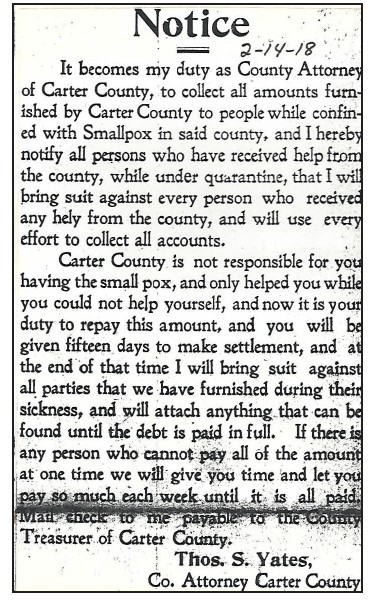
It also seems that issues with financing during these epidemics are nothing new. While many currently report having difficulty getting the unemployment benefits promised by the state, in 1918 the county was intent on getting back funds provided to those quarantined due to smallpox. Thomas Yates, then Carter County Attorney, published the following notice in large type in a February 14, 1918 paper; 

On the same day, the following was printed regarding the community of Olive Hill; 

So, it seems that the government stepping in and forcing public protection steps, be it vaccination for smallpox or face coverings for COVID-19, isn’t anything new. It also seems that folks expressed concerns about forced intervention, and whether or not acting earlier could have made a difference, then just as they do today. But, eventually, the illness passed and things returned to normal. Let’s all take the chance to learn from our history and do our parts – whether wearing masks or face shields, or social distancing – to help us get past COVID-19 as Carter County did to get past smallpox in 1918. 

Editor’s Note: This is the first in a series of articles drawn from the historical newspaper clippings in the scrapbooks of Jack Fultz. When necessary typographical errors and misspellings in the original have been corrected for clarity. We thank Sally James of Sally’s Flowers in Olive Hill for sharing her uncle’s collected clippings with us and the community. – Jeremy D. Wells, editor, Carter County Times